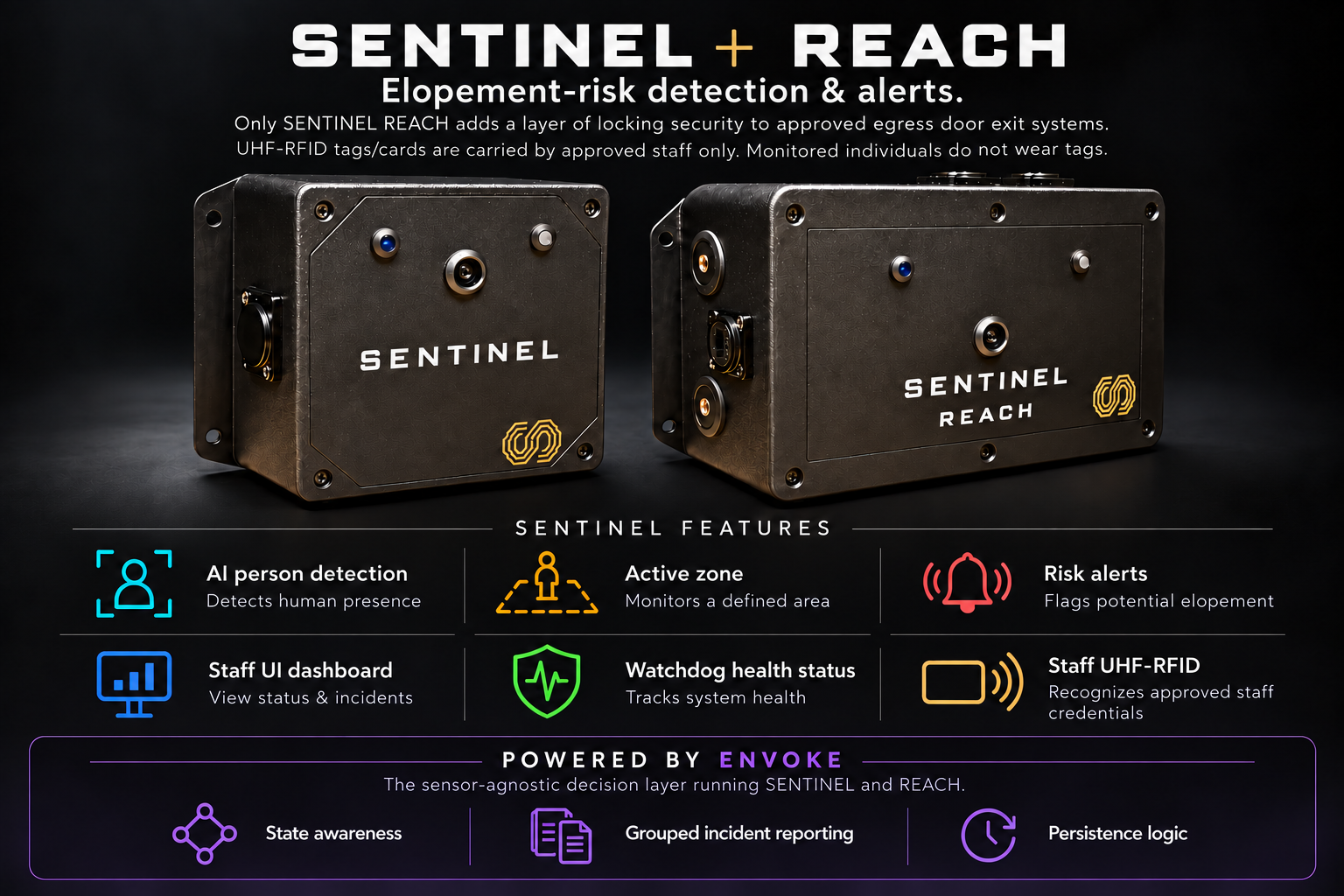
SENTINEL™ & SENTINEL Reach™ prevent elopement without the stigma of wearing the solution.
Sentinel and Sentinel Reach are bolt-on AI monitoring & UHF-RFID devices — alert-only or selective access-control — purpose-built for special education classrooms, care facilities, or private use.
No facial recognition. No infrastructure overhaul. No wearable for a student or patient to keep on, lose, or be seen wearing.
Both models are embedded intelligent environmental monitoring and alerting devices powered by Syndritek’s Sensor Agnostic Decision Architecture, ENVOKE.
Sense ▶️ Events ▶️ World Model ▶️ Behavior State ▶️ Action ▶️ Iterate ▶️
Sense ▶️ Events ▶️ World Model ▶️ Behavior State ▶️ Action ▶️ Iterate ▶️
NOTHING WORN. NO STIGMA.
Every existing approach to elopement starts with the same assumption: place a staff member at the door, or give the child something to wear and track them. In practice, wearables get pulled off, resisted, or forgotten — and being visibly "tagged" changes how a student is treated by classmates. Staff are stretched too thin to stand as a door guard at all times. The safety measure becomes the thing that sets a student apart.
SENTINEL and SENTINEL Reach invert that logic entirely. The intelligence lives in the environment, not on the person. Nothing to put on. Nothing to remove. Nothing that marks a student as different from their peers — just a highly aware system that knows who's supposed to be in the active zone, and what response is appropriate: staff notification, or layered door-locking protection.
PROTECT OUR MOST VULNERABLE.
Seen firsthand as an educator, elopement is one of the most dangerous, persistent risks in special education classrooms. There has been shockingly little to no solution for this — so I designed and built it at Syndritek Labs.
Students with autism and other behavioral needs frequently attempt to leave supervised spaces unnoticed — a safety risk for the student and a serious liability for schools and staff. Existing solutions are either expensive infrastructure retrofits or manual supervision that can't scale.
Sentinel and Sentinel Reach are different.
They are simple, self-contained devices that bolt onto any existing door — no rewiring, no networking overhaul, no new construction. They combine real-time AI person-detection with UHF-RFID authentication to recognize an elopement risk and alert staff automatically, with event status data logged in real time. Sentinel Reach adds layered locking on egress for the most challenging cases.
This is more than a smart-lock access system — it functions as real-time selective access and restriction. If there's no elopement in process, the door remains unlocked as usual. The moment a student enters the active zone without staff or proper RFID authentication present, the magnetic lock stops the door from being opened until the student leaves the zone or activates the egress mechanism. Approved staff carry authenticated RFID and pass freely without lock engagement.
Sentinel Reach includes a long-range wireless FOB that overrides any programming and disables the magnetic lock — the teacher can use it from their desk — and complies with building and fire code regulations requiring multiple, software-independent lock-disabling mechanisms.
Sentinel and Sentinel Reach use AI person-detection only — never facial recognition — making deployment in schools straightforward without raising student privacy or biometric-data concerns.
Expanded capabilities include general data and analytics monitoring. While individual identities are intentionally excluded from the logic, elopement-trend and other data for the classroom can be logged, visualized and understood.
TWO WAYS TO PROTECT A ROOM. ONE CORE INTELLIGENCE.
Nothing worn by the person at risk, ever.
Every Sentinel runs on Syndritek’s perception layer, ENVOKE, our biological-systems-inspired AI decision architecture — the same detection intelligence in every install. What differs is whether the device also controls the door, or other platform entirely. Choose the tier that fits where your site is today.
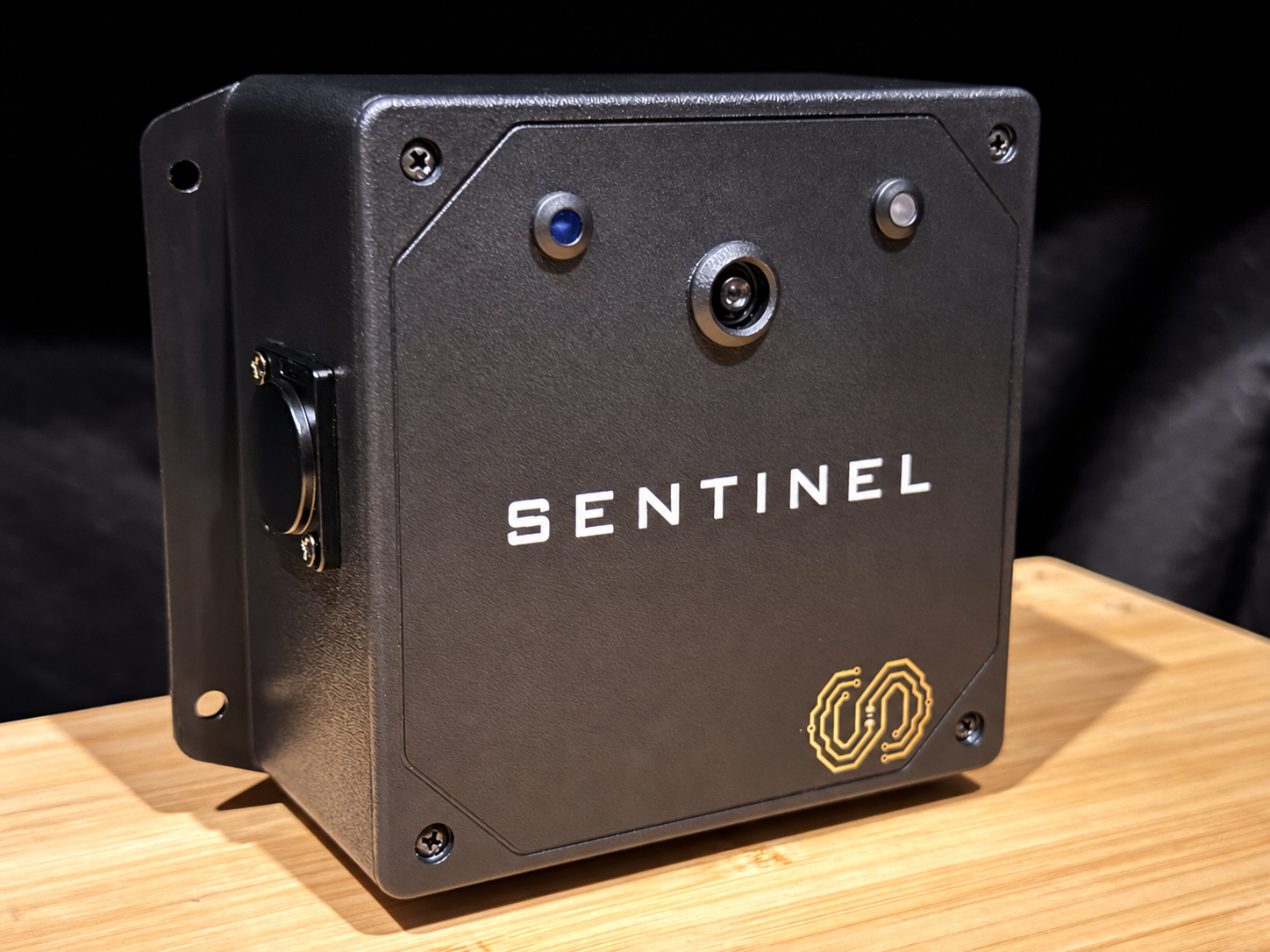
SYSTEM #1: SENTINEL (Non-Locking Model)
Elopement risk, caught the moment it starts.
An extra set of eyes on the door — always watching, never distracted, and quiet when it should be.
Sentinel pairs AI person-detection with RFID identification to catch unsupervised elopement risk in real time and alert staff instantly. No lock, no fire-code approval process, no construction. Installed in days.
The Problem
Nearly half of autistic children elope after age four. Sixty percent of people with dementia will wander. The moment it happens is rarely dramatic — it's a door left unwatched for thirty seconds during a shift change, a redirection that didn't land, a hallway nobody happened to be looking down. Existing solutions ask a child or resident to wear something. Sentinel doesn't.
How It Works
Detect — AI person-detection identifies who's in the risk zone, continuously, without anyone having to watch the door themselves.
Identify — RFID confirms who's present, including whether a staff member is already supervising. Nothing worn by the person at risk, ever.
Decide — This is where Sentinel is more than a camera. It tells the difference between a genuine unsupervised risk and a normal staff-escorted moment — a bathroom trip, dismissal, recess — and stays quiet when it should. That distinction is what keeps staff from tuning out constant false alarms.
Alert — When it's real, staff are notified instantly, wherever they are. A badge tap near the door acknowledges the alert and logs the response — stand-down and documentation in one motion.
What It Doesn't Do
Sentinel doesn't touch the lock. No fire-code involvement, no AHJ approval cycle, no sprinkler-system requirement. That's not a limitation — it's the whole point of this tier: real protection, installed this month, in any building. When a site is ready for physical lock control, Sentinel Reach adds that layer on the same core hardware.
Beyond the Alert: Data That Matters
Every detection event, every alert, every staff response is logged with a timestamp. Over weeks and months, that becomes something most classrooms and care units have never had before: a real record of when and where risk actually happens — which shift, which hour, which doorway. That's not just documentation. It's the pattern staff have always sensed but never had proof of.
Ideal For
First pilots and proof-of-value installs
Buildings without sprinklers or full fire detection (a requirement for Reach, not for Sentinel)
Budget-conscious sites wanting protection now
Anywhere you want real usage data before committing to a fire-marshal approval process
FAQ
Does this need fire marshal approval? No — Sentinel never touches the door, so it's outside that process entirely.
Can we upgrade to Reach later? Yes. Same enclosure, same ENVOKE sensor agnostic architecture — lock-control hardware gets added, not replaced.
What does the person at risk wear? Nothing. Ever. That's true in both tiers.
How fast can this be installed? Days, not months — no contractor, no inspection cycle.
SYSTEM #2: SENTINEL Reach (Locking Model)
When alerting isn't enough — the door doesn't open either.
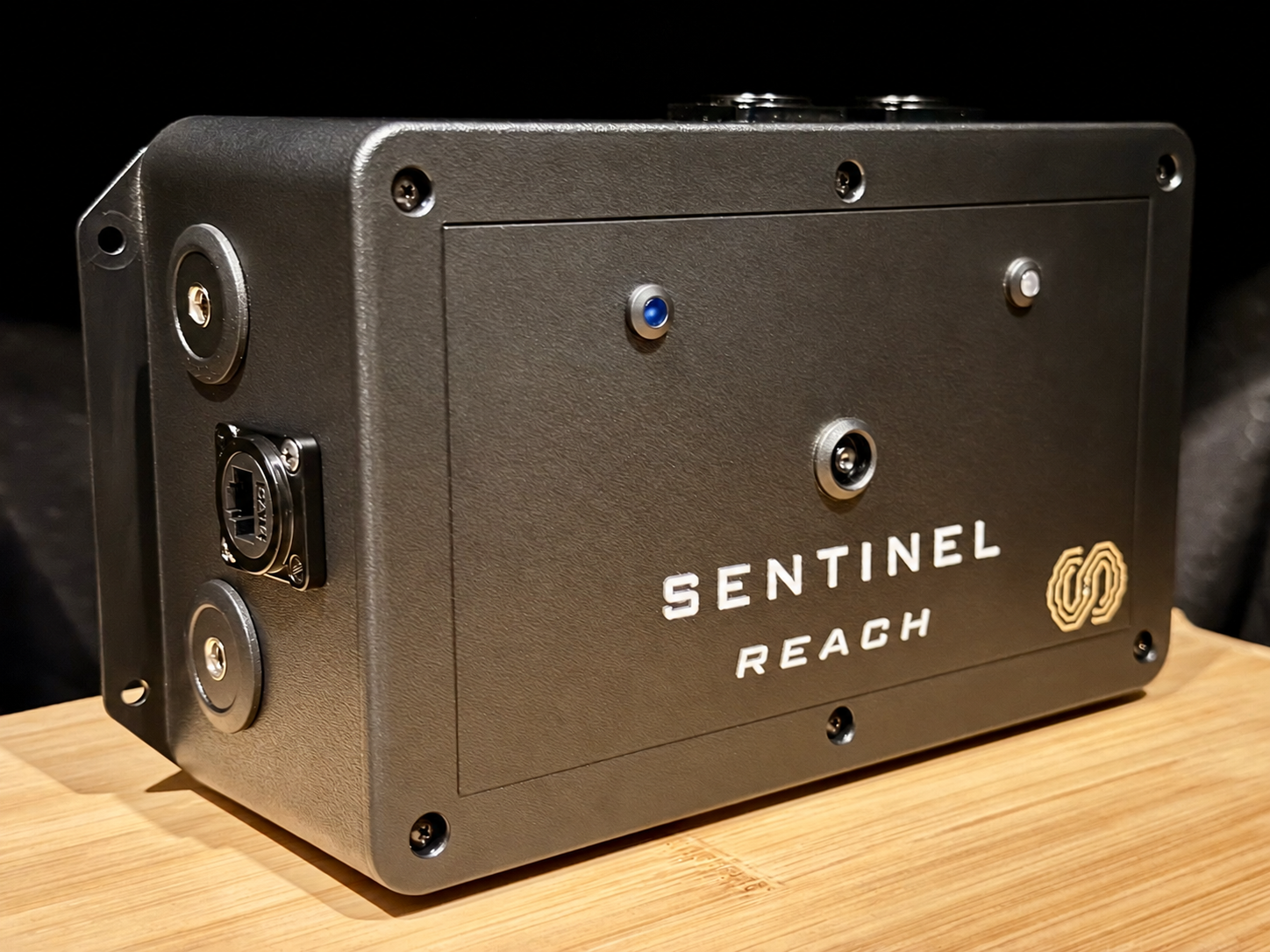
The same intelligence as Sentinel, with one more layer: a fail-safe, code-compliant lock that holds until the risk clears — never at the cost of a real emergency.
Sentinel Reach adds delayed-egress locking, installed by a licensed fire-alarm contractor and signed off by your local fire marshal — the same process as any commercial access-control door.
The Problem
An alert gives staff a chance to respond. It doesn't buy time on its own — and for the moments when a few seconds matter most, a locked door does something an alert can't: it holds the line while help arrives. Sentinel Reach exists for the sites and situations where physical prevention, not just notification, is the right layer of protection.
How It Works
Detect — The same AI person-detection as every Sentinel — continuous, no one has to watch the door themselves.
Identify — RFID confirms who's present, including whether staff are already supervising. Nothing worn by the person at risk, ever.
Lock — When Syndritek’s perception layer determines a genuine unsupervised risk, the door engages — fail-safe, meaning it only stays locked as long as it's actively powered to do so.
Release — The lock releases automatically and immediately on fire alarm activation, sprinkler activation, or loss of power — hardwired, independent of software, so a system fault can never trap anyone inside. If someone at the door pushes to exit, release follows on its own timed cycle, exactly as required by code.
Built to Code, Not Around It
Delayed-egress locking for exactly this use case isn't a gray area or a workaround — it's a named, specific provision. IBC/IFC §1010.2.12 and NFPA 101 §7.2.1.6.1 permit delayed-egress locks on classroom doors in educational occupancies specifically to deter elopement of students with special needs, and equivalent healthcare-occupancy provisions have protected wandering-risk residents in memory care for even longer. Sentinel Reach was built for the use case the code already anticipated — not adapted from a retail security product after the fact.
Every install includes:
A dedicated fire-alarm interconnect, wired independent of any software layer
A certified REX (request-to-exit) sensor at the door, with its own release timer
Installation by a licensed fire-alarm contractor and sign-off from your local fire marshal
Ideal For
Sites ready for full physical prevention, not just alerting
Buildings with sprinklers or approved fire detection already in place (required for delayed-egress locking)
Memory care facilities carrying real wandering-related litigation and citation exposure
Schools and facilities that piloted Sentinel and are ready for the next tier
FAQ
What happens in a fire? Instant release — no delay, no software decision, hardwired directly to the fire alarm system.
What if the power goes out? Fail-safe by design: loss of power de-energizes the lock and it opens on its own.
Can someone get trapped if the software crashes or hangs? No. The release path for fire, power loss, and a manual exit attempt is physically independent of software — the AI decides when to lock, never when to release.
How long does installation take? Longer than Sentinel — expect a fire-alarm contractor and an AHJ inspection/sign-off cycle as part of the timeline.
What does the person at risk wear? Nothing. Ever. Same as Sentinel.
Can we start with SENTINEL and move to Reach later? Yes — same Syndritek layer core. Lock-control hardware is built into a larger enclosure unit. You can trade in SENTINEL as credit for the REACH unit.
[ Request a Consultation ]
OUR TECHNOLOGY
Syndritek’s “ENVOKE” is the decision engine behind Sentinel — not a sensor trigger, but an system that builds understanding over time.
Most access-control systems react to a single signal: a badge scan, a motion trip. ENVOKE doesn't. It continuously fuses input from multiple sources into one persistent picture of what's actually happening in the room, then decides — and acts — based on that fuller context.
How it works, step by step:
Sense — Sensors detect changes in the environment
Interpret — Raw signals become meaningful events, not noise
Model — ENVOKE maintains a persistent picture of the space over time
Decide — The current state and intent determine the right response
Act — The system executes — unlock, lock, notify
Iterate — Continuously adapts as the environment changes
Built to extend beyond the classroom. Because ENVOKE is modular and sensor-agnostic, the same architecture that powers Sentinel today is built to extend into security, inventory monitoring, and robotics applications tomorrow.
WHO WE ARE
Founded on firsthand experience. Syndritek Labs was founded by Mershan Ferris, who combines a background in cell and molecular neuroscience with hands-on experience in computer hardware, programming, special education and finish carpentry. Sentinel was born directly out of a need seen firsthand: classrooms lacked technology built for elopement risk — so we built it.
Inspiration from first-order biological principles allowed us to develop a unique, highly modular, environment-and-event-based software architecture for Sentinel.
Mission: Engineering intelligent machines through modular decision architecture.
(Patent process initiated)